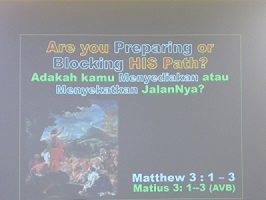
“Are You Preparing or Blocking His Path” by Rev. Poh on 16th Feb 2020
John the Baptist was the most significant figure in the Bible. When he was asked whether he was the Christ, he denied it. He was the one who prepared the way for the Lord and make a straight path for Jesus (Mat3:3). The preacher Rev. Poh narrated an example whereby the traffic police escorts comes before the cyclist to open the way during the recent Le Tour de Langkawi cycling race which was held in the city of Kuching as reference to the role played by John the Baptist. He added Apollo, being one of the followers of John the Baptist only knew the baptism of John by water (Acts 18:25) and continued to preach the way of the Lord (Luke 3:16). He explained that John’s baptism was with water and is the baptism of repentance. Rev Poh explained that John the Baptist knew his identity and his duty well and that was why he chose to live in the wilderness by living a simple life. He observed that it was also one of the reasons why those people during John the Baptist’s time could concentrate on the message because there was no distraction. “As compared to our city life, this is where we can be so easily distracted from all sorts of worldly matters. Baptism by water cannot give us a new life, but Jesus can. John (the Baptist) indicated that the one who comes after me will baptise with the Holy Spirit. He is the one who can transform your life. Only at the moment of time when you know that Jesus can give you the assurance of eternal life through the Holy Spirit, your life is reborn,” Rev Poh said. So, are we preparing the way for the Lord or are we blocking the way for Jesus? In response, we must be like a tree planted by streams of water, which yields its fruits in season (Psalms 1:3). As in Matthew 24:14,”This gospel of the kingdom will be prepared in the whole world as a testimony to all nations, and then the end will come.” So are we a stumbling block to His path? Therefore, we need to ask ourselves whether we are projecting the image of a good Christian in our speech and conduct in our daily lives (1Tim 4:12). If not, we need to come to God humbly and repent.


